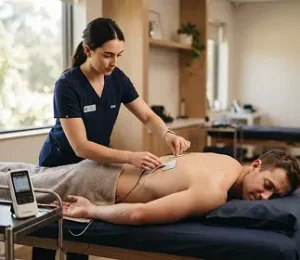
SAY GOODBYE TO frozen shoulder

From pain relief to improved shoulder mobility, our certified specialists provide evidence-based physiotherapy treatments to reduce stiffness, restore range of motion, and support long-term recovery.

Common Causes

What drives frozen shoulder

Yes, physiotherapy plays a vital role in managing and shortening the duration of Frozen Shoulder (Adhesive Capsulitis). Through targeted joint mobilization, progressive range-of-motion stretching, and pain-relieving techniques, physiotherapy helps restore shoulder mobility and prevent permanent stiffness.

Prolonged Immobilization

Gender & Age Factors

Post-Traumatic Inflammation

Symptoms

What does frozen shoulder feel like?

Frozen shoulder typically progresses through three stages (Freezing, Frozen, and Thawing) with distinct symptoms:

Severe Shoulder Pain

Deep, dull, or aching shoulder pain that is often worse at night or when lying on the affected side.

Severe Stiffness & Restricted Range

Inability to raise your arm overhead, reach behind your back (e.g., reaching for a seatbelt or fastening a bra), or reach out sideways.

Loss of Both Active and Passive Movement

The shoulder cannot move whether you try to lift it yourself or someone else attempts to move it for you.

Compensatory Movements

Elevating your entire shoulder blade or twisting your body to compensate for the stiff shoulder joint.


Symptoms

When to see a physiotherapist?

You should schedule an assessment with a physiotherapist if:

You notice a gradual, unexplained loss of shoulder movement over several weeks.

Simple tasks like dressing, combing hair, or reaching overhead become increasingly painful or impossible.

Shoulder pain interrupts your sleep whenever you turn onto your side.

Important medical warning

WHEN TO SEE A DOCTOR IMMEDIATELY

Assessment

How we assess frozen shoulder at Plan B

At Plan B Physio, our structured clinical assessment process includes:

Active vs. Passive Range of Motion Testing

Differentiating adhesive capsulitis from muscle conditions like rotator cuff tears.

Capsular Pattern Assessment

Checking restricted movement, especially external rotation and overhead reach.

Scapulohumeral Rhythm Evaluation

Observing how your shoulder blade moves relative to your arm.

Soft Tissue & Pain Tolerance Screening

Identifying safe stretch boundaries and muscle guarding around the shoulder joint.

Treatment

How we treat lower back pain

Depending on your clinical findings, your treatment plan may include:

Joint Mobilization (Maitland / Mulligan Techniques)

Gentle passive joint glides to stretch the tight joint capsule safely.

Progressive Range of Motion Exercises

Assisted stretching and pulley exercises to reclaim shoulder movement.

Soft Tissue Release

Relieving secondary muscle tightness in the chest, upper back, and neck.

Pain Management Modalities

Heat therapy, dry needling, or electrotherapy to soothe deep joint aching.

REALISTIC RECOVERY TIMELINES

What to expect

Frozen shoulder is a condition that resolves slowly, but consistent physiotherapy significantly accelerates recovery:

Phase 01

Freezing / Acute Phase
(Pain Predominant)

EXPECTED DURATION

Typical sessions

6-10
sessions

Est. duration

1-2
months

Manage night pain, reduce inflammation, and maintain existing mobility.

Phase 02

Frozen Phase
(Stiffness Predominant)

EXPECTED DURATION

Typical sessions

10-16
sessions

Est. duration

2-4
months

Aggressive capsule stretching, joint glides, and active movement gains.

Phase 03

Thawing Phase
(Recovery)

EXPECTED DURATION

Typical sessions

8-12
sessions

Est. duration

2-3
months

Full functional range restoration, rotator cuff strengthening, and return to daily activities.

Our team

Who treat this

Recovery varies based on severity, age, and activity level. While we never guarantee exact timelines, typical recovery phases include:

Alex Cheah

Director & Senior Physiotherapist

Bryan Chiam

Branch Manager & Senior Physiotherapist

Darren Lim

Senior Physiotherapist

Ee Hang

Senior Physiotherapist

Daphne Shu

Branch Manager & Senior Physiotherapist

Hannah Tan

Branch Manager & Senior Physiotherapist

Shavonne Choi

Senior Physiotherapist

Cecilia Hoon

Physiotherapist

Yap Shi Qi

Regional Director / District Manager

Ng Wei Shan

Senior Physiotherapist

Daphne Low

Senior Physiotherapist

Ju Kah Yi

Senior Physiotherapist

Chang Han Shen

Branch Manager & Senior Physiotherapist

Shee Zhe Pin

Head Coach

Medhavinz Seew Ravindran

Trainer

Our branches

Where to get treated

Receive specialized lower back pain care at any of our accessible Plan B branches:

First trial session

RM 220

one-time session

Pricing &
First Trial

Start your shoulder recovery journey with a clinical assessment and trial session.

What's included

View our complete pricing and package options here:

QUESTIONS, Answered.

Still not sure? Our team is happy to answer any questions before you book.

Is Frozen Shoulder the same as a Rotator Cuff tear?

No. Rotator cuff tears involve muscle/tendon damage where someone else can still lift your arm passively. Frozen shoulder involves capsule stiffness where the arm is locked even when moved passively.

No! Pushing into severe pain causes muscle guarding and increases inflammation. Gentle, controlled stretches guided by a physiotherapist yield better results.

Without treatment, it can take 1.5 to 3 years to resolve. Physiotherapy helps shorten this timeframe and prevents permanent mobility loss.

It is best to avoid sleeping on the painful side. Support your affected arm with a pillow across your chest when sleeping on your back or opposite side.

Wear a loose tank top, sleeveless top, or sports bra so your therapist can easily examine and treat your shoulder joint.

Ready to
live pain-free

Reclaim your shoulder movement today. Click below to chat directly with our team on WhatsApp for free advice or to book your trial session.