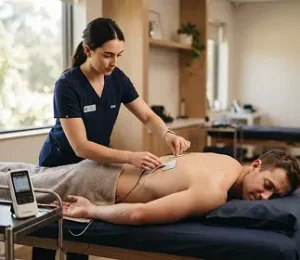
From nerve pain relief to improved mobility, our certified specialists provide evidence-based physiotherapy treatments to reduce nerve irritation, relieve pain, and restore comfortable movement.
What drives Sciatica
Yes, physiotherapy is one of the most effective non-invasive treatments for sciatica. By releasing compressed sciatic nerve roots, relaxing tight piriformis/gluteal muscles, and improving spinal alignment, physiotherapy provides rapid symptom relief and prevents chronic nerve irritation.
Lumbar Disc Herniation
Piriformis Syndrome
Spinal Stenosis
Symptoms
What does sciatica
feels like?
Sciatica characteristically affects one side of the lower body, following the path of the sciatic nerve:

Burning or Electric Shooting Pain
Sharp, shock-like pain running from the lower back through the buttock and down the back of the leg.

Numbness & Tingling
Loss of sensation or a "pins and needles" feeling in the calf, ankle, or foot.

Aggravated by Sitting
Pain worsens when sitting for long periods, standing up, or coughing.

Leg Weakness
Feeling like your affected leg is heavy, weak, or buckling during walking.

Symptoms
When to see a physiotherapist?
You should schedule an assessment with a physiotherapist if:
You feel continuous burning pain or numbness traveling down your leg.
Walking, standing, or sitting for more than 15 minutes triggers leg discomfort.
Home stretches or resting do not ease the sharp buttock and leg pain.
Important medical warning
WHEN TO SEE A DOCTOR IMMEDIATELY
How we assess sciatica
at Plan B
Our physiotherapists perform a targeted nerve and structural evaluation:
Performing the Straight Leg Raise (SLR) and Slump test to reproduce and confirm sciatic nerve entrapment.
Determining whether the nerve irritation originates from the spine or the hips.
Palpating deep hip rotators to check for Piriformis Syndrome.
Mapping sensory loss or motor weakness in the leg and foot.
How we treat sciatica
Our comprehensive sciatic nerve relief approach includes:
Neural Mobilization & Nerve Gliding
Gentle manual techniques that slide the sciatic nerve safely through surrounding tissues.
Deep Tissue & Piriformis Release
Myofascial release targeting gluteal spasms to eliminate localized nerve pressure.
Spinal Decompression
Relieving vertical pressure on lumbar discs to unpinch nerve roots.
Postural & Core Retraining
Strengthening core muscles to keep the pelvis aligned and take pressure off the lower back.
What to expect
Recovery varies based on severity, age, and activity level. While we never guarantee exact timelines, typical recovery phases include:
Phase 01
Muscular Sciatica (Piriformis Syndrome)
EXPECTED DURATION
4-8
sessions
3-5
weeks
Fast pressure release, muscle relaxation, and rapid leg pain reduction.
Phase 02
Disc-Related Sciatica (Moderate)
EXPECTED DURATION
8-14
sessions
2-3
months
Decompress spinal nerve roots, restore leg strength, and prevent future compression.
Phase 03
Severe / Chronic Stenosis Sciatica
EXPECTED DURATION
12+
sessions
3+
months
Pain management, functional gait training, and long-term mobility retention.
Who treat this
Recovery varies based on severity, age, and activity level. While we never guarantee exact timelines, typical recovery phases include:

Alex Cheah
Director & Senior Physiotherapist

Bryan Chiam
Branch Manager & Senior Physiotherapist

Darren Lim
Senior Physiotherapist

Ee Hang
Senior Physiotherapist

Daphne Shu
Branch Manager & Senior Physiotherapist

Hannah Tan
Branch Manager & Senior Physiotherapist

Shavonne Choi
Senior Physiotherapist

Cecilia Hoon
Physiotherapist

Yap Shi Qi
Regional Director / District Manager

Ng Wei Shan
Senior Physiotherapist

Daphne Low
Senior Physiotherapist

Ju Kah Yi
Senior Physiotherapist

Chang Han Shen
Branch Manager & Senior Physiotherapist

Shee Zhe Pin
Head Coach

Medhavinz Seew Ravindran
Trainer
Where to get treated
Receive specialized lower back pain care at any of our accessible Plan B branches:
Plan B Midtown (HQ)
Plan B Uptown Pilates
Plan B Sutera
Plan B SK Arena
Plan B Bukit Jalil
First trial session
RM 220
one-time session
Pricing &
First Trial
Start your journey toward burning pain relief with our targeted nerve assessment and first treatment.
What's included
View our complete pricing and package options here:
QUESTIONS, Answered.
Still not sure? Our team is happy to answer any questions before you book.
Muscle strain usually causes localized soreness. Sciatica causes traveling, burning, or electric pain that shoots down below the knee into the foot.
Short, gentle walks on flat ground can help circulate blood and ease stiffness. However, avoid long strides or fast walking if it aggravates the shooting pain.
Yes! Aggressively stretching a severe, inflamed sciatic nerve can irritate it further. Nerve gliding exercises guided by a professional are much safer.
Lying down or curling up in certain sleeping positions can put extra pressure on lumbar nerves or increase deep hip muscle tension.
Wear comfortable, loose sports pants or shorts that allow easy testing of your legs and lower back.
Ready to
live pain-free
Say goodbye to shooting leg pain. Click below to chat directly with our team on WhatsApp for free advice or to book your first trial session.
Select your Branch